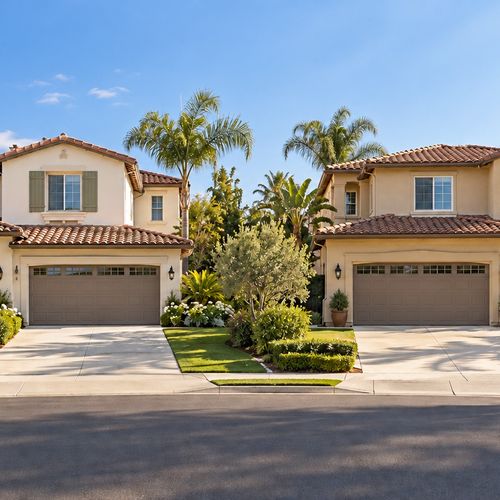



AI-generated illustration; not actual properties or transactions.
“I’m not selling my house for $100,000 less.”
That may be a sensible decision. It may also be a decision made with only half the numbers.
If you’re selling one Orange County home to buy another, your sale price is only one side of the move. The other side is what you’ll pay for the home you want next.
Your home can lose value while the price gap to your next home gets smaller.
Here’s how—and what I would check before recommending that you act on it.
The $100,000 drop that narrows the gap by $50,000
Hypothetical comparison—not actual properties, transactions, or a forecast.
Imagine the same two homes under two different pricing scenarios. These figures represent assumed achievable sale prices, not asking prices or online estimates.
Scenario A: Higher prices
- Your current home sells for $1,200,000.
- The home you want costs $1,800,000.
- The difference is $600,000.
Scenario B: Both homes sell for less
- Your current home sells for $1,100,000.
- The home you want costs $1,650,000.
- The difference is $550,000.
Your sale price fell by $100,000. The replacement home’s price fell by $150,000. The gap narrowed by $50,000.
Both prices declined by approximately 8.3%. The larger dollar reduction came from the more expensive home.
That does not mean you became wealthier. Your home equity declined. It means the additional purchase price required to move up became smaller, before transaction costs and financing.
Waiting for your home’s old price to return is not automatically the same as waiting for a better move.
The price gap is not your mortgage balance
Let’s take the example one step further.
Assume you owe $400,000 on your current home in both scenarios and put all sale proceeds after that payoff toward the next purchase. Set transaction costs and cash reserves aside temporarily so we can isolate the arithmetic.
In Scenario A, a $1.2 million sale leaves $800,000 after the mortgage payoff. Applied to a $1.8 million purchase, that means a $1 million new loan.
In Scenario B, a $1.1 million sale leaves $700,000 after the payoff. Applied to a $1.65 million purchase, that means a $950,000 new loan.
You bring $100,000 less equity into the purchase, yet need to borrow $50,000 less.
For a real move, I would replace these simplified figures with estimated net sale proceeds, purchase costs, and the cash you want to keep available. That includes selling expenses, agreed credits, repairs, moving costs, and any overlap between homes.
The useful question is how much money the entire move requires.
A smaller loan can still mean a much bigger payment
This is where a persuasive headline needs a serious reality check.
Using an illustrative 6.5% fixed interest rate over 30 years for both new loans, principal and interest would be approximately:
- $1 million loan: $6,321 per month.
- $950,000 loan: $6,005 per month.
That is about $316 less each month in Scenario B. The rate is an assumption, not a current quote; these payments exclude taxes, insurance, HOA dues, and other ownership costs.
But both numbers could be substantially higher than the payment on the home you already own—especially if you have a smaller balance and a low fixed rate.
Cheaper than the earlier move-up scenario does not mean cheaper than staying.
I would compare your actual current payment with the proposed total housing budget. The CFPB’s Loan Estimate guide explains where to check principal and interest, projected payments, closing costs, and cash needed at closing.
If the move only works after an assumed future refinance, I would treat that as a problem to resolve before proceeding.
In Orange County, check the home you’re buying as carefully as the one you’re selling
The two homes in the example moved by the same percentage. Real properties do not have to cooperate that neatly.
An Irvine home you own and a Fullerton home you want may have different competition, condition, property types, and buyer demand. Even two homes in the same city need separate analysis.
I would establish a supported price range for each side using relevant recent sales and current alternatives. A countywide average cannot tell us what either specific home will sell for.
Then I would verify the replacement property’s HOA dues, insurance quote, and parcel-specific taxes and assessments.
Do not simply carry the seller’s current property tax bill into your budget. A reassessable purchase establishes a new taxable base value, and supplemental taxes may follow. The Orange County Assessor explains the process. Any applicable exclusion or tax-base transfer needs individual verification.
What I would put in front of you before recommending a move
When we discuss selling your Orange County home, I would want the sale and replacement purchase evaluated together.
First, what you can actually take into the next purchase.
I would estimate sale proceeds across a realistic price range, after the mortgage payoff and expected selling expenses. We would also decide how much cash stays in reserve.
Second, what the next home solves.
More usable space? A different layout? A shorter commute? We would compare homes that meet that need, rather than assume a higher price automatically delivers a better fit.
Third, what happens if the favorable assumptions fail.
Suppose your home sells for $50,000 less than expected and the replacement seller will not negotiate. Does the move still fit your budget? What if you need temporary housing or repairs immediately after closing?
I would coordinate financing estimates with your lender and work through the timing before recommending an offer.
Sometimes the result will support moving. Sometimes it will support waiting, choosing a different property, or improving the home you already own.
A useful analysis should be able to reach any of those conclusions.
Three questions homeowners ask
Should I sell for less just to get a cheaper next home?
Only if the full comparison supports it. A smaller price gap is a starting point. Net proceeds, financing, ownership costs, timing, and your reasons for moving determine whether it makes sense.
Does this mean Orange County home prices are falling?
No. The example illustrates how two prices interact. It makes no claim that a particular city, neighborhood, or property has declined by these amounts.
What if I am downsizing instead?
Run the same calculation in reverse. If both properties fall by the same percentage, the more expensive home you are selling loses more dollars than the cheaper replacement. That can reduce the equity you release before costs.
Find out what your next move actually costs
Before deciding you cannot afford to sell—or that you should—put both homes into the same calculation.
Text MOVE to 949-572-7098, along with your property address and the area or type of home you want next. I’ll help you compare your likely sale proceeds with the replacement purchase and identify what needs to be verified with your lender before you make a decision.
You can also contact me here.
James Deokar
JD Signature Real Estate
Irvine CA Realtor | Orange County Real Estate
CA DRE #02200040
[email protected]
Check out this article next