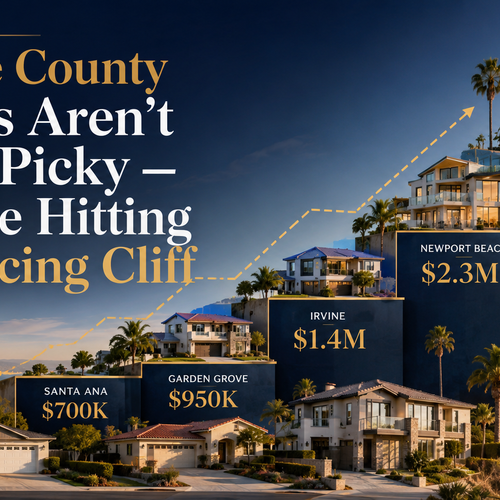



Most Orange County homebuyers do something that seems completely logical.
They decide the most they are comfortable spending on a home, open Zillow or Redfin, enter that number as their maximum price, and start searching.
If the budget is $1.5 million, the search stops at $1.5 million.
It feels financially responsible.
But in parts of Orange County right now, that simple decision could be hiding homes the buyer could actually afford.
I call it the Zillow Filter Trap.
And when I looked at the July 2026 housing numbers across Orange County, Irvine, Tustin, Costa Mesa, Anaheim and Fullerton, something jumped out at me: the price a home is advertised for and the price buyers are ultimately paying are behaving very differently depending on where you're looking.
That means your maximum purchase price and your maximum search price may not always be the same number.
The List Price Is Really Just the Beginning of a Conversation
For years, Orange County buyers became conditioned to treat a home's asking price almost like an opening bid.
A home came on the market at $1.5 million and buyers immediately wondered how far over $1.5 million they would have to go.
That mentality hasn't completely disappeared. In fact, there are still Orange County markets where homes are selling above asking.
But it isn't happening everywhere.
According to July 2026 RPR market data covering single-family homes, condos and townhomes, Irvine's sold-to-list-price ratio was 97.1%.
Fullerton was 101.2%.
Anaheim was 101%.
Tustin was 99.4%.
Costa Mesa was 98.1%.
Orange County overall was 99.2%.
Think about what that means for the way people search for homes online.
Two buyers can have exactly the same budget but need completely different search strategies depending on where they're looking.
What Happens to a $1.5 Million Buyer in Irvine?
Let's use a buyer whose absolute purchase ceiling is $1.5 million.
If that buyer enters $1.5 million as the maximum price on Zillow, every home listed at $1,510,000, $1,525,000 or $1,550,000 disappears.
The buyer never considers it.
They don't study the photos. They don't see how long it has been listed. They don't notice whether the seller already reduced the price. They don't compare it with recent sales. They never get far enough to ask whether the seller might negotiate.
The algorithm simply removes the house from the conversation.
Now look at Irvine's July sold-to-list ratio of 97.1%.
Mathematically, a $1.5 million final sale price would equal approximately 97.1% of a $1.545 million list price.
That's roughly $45,000 above the buyer's original Zillow search ceiling.
To be clear, that does NOT mean every Irvine home listed at $1.545 million can be purchased for $1.5 million. Real estate doesn't work that way, and a citywide statistic should never be used to predict the selling price of an individual property.
But it does show why automatically eliminating every property above your target purchase price can be a mistake.
The house you can't afford at its asking price may be a completely different conversation after 30 days on the market.
And right now, that 30-day mark matters.
Irvine's 35-Day Number Makes This Even More Interesting
July's median time on market in Irvine was 35 days.
Orange County overall was 19 days.
Fullerton was just 14 days, Anaheim 15, Costa Mesa 16 and Tustin 20.
At the same time, Irvine had 4.47 months of inventory compared with 2.93 months countywide.
That's a very different environment from the market buyers became accustomed to when desirable Orange County homes seemed to disappear almost immediately.
The interesting opportunity isn't simply that "homes are sitting longer."
Everyone is talking about that.
The more important question is what buyers are doing with that extra time.
If a property has been sitting for several weeks, has already experienced a price reduction, or the seller's expectations were simply ahead of where buyers saw the market, its current asking price shouldn't necessarily determine whether the property ever appears on your radar.
That is where the search-filter problem begins.
In Fullerton and Anaheim, the Math Flips
This is where the story gets even more interesting.
A buyer shouldn't take what is happening in Irvine and blindly apply it everywhere else.
Fullerton's July sold-to-list ratio was 101.2%, while Anaheim's was 101%.
So a $1.5 million buyer searching in one of those markets may have the opposite problem.
If the right properties are routinely attracting offers around or above asking, searching all the way up to your absolute financial ceiling can leave you with nowhere to go when competition appears.
Using the same simple mathematical illustration, a $1.5 million final purchase at 101.2% of list corresponds to a list price of roughly $1.482 million.
Again, that isn't a formula for what to offer.
It's evidence of something more important: a single price filter is a surprisingly crude way to shop for a home.
And yet that's exactly how millions of people begin their search.
Buyers Are Becoming More Price Sensitive at Exactly the Same Time
This matters even more because borrowing costs have moved higher again.
Freddie Mac reported that the average 30-year fixed mortgage rate reached 6.69% on August 6, 2026. Earlier in the year, buyers saw rates dip below 6% before they began climbing again.
That makes today's buyer incredibly sensitive to price.
Meanwhile, Realtor.com's July housing report found that 20% of listings nationally had experienced a price cut, with the West showing an even higher 21.9% share.
So we have an unusual combination developing.
Buyers are extremely budget conscious.
More sellers are adjusting prices.
Negotiating conditions vary significantly from one city to another.
And yet most online home searches still begin with one rigid number: maximum price.
That's the disconnect.
The Smart Search Is Wider Than the Zillow Search
I don't think buyers should start shopping irresponsibly above their budgets. I also don't think anyone should assume that an overpriced home automatically equals a deal.
The better approach is more deliberate.
There is a difference between what you are willing to pay and which properties are worth investigating.
When I'm evaluating where the real opportunity might exist, the asking price is only one part of the story. How long has the property been available? Has the price already changed? What did comparable homes actually close for? Is the seller competing against several similar listings? Is this the type of property buyers are fighting over, or the type they're currently passing by?
Those questions tell us far more about negotiating room than a Zillow maximum-price box ever will.
A buyer's search can therefore have two numbers: the real purchase ceiling and a strategic search ceiling.
Those numbers might be identical.
Or, depending on the property and the local market, they might not be.
Sellers Should Pay Attention to This Too
There's another side of the Zillow Filter Trap that Orange County sellers shouldn't ignore.
Your asking price doesn't just tell buyers what you want.
It determines which buyers see you at all.
Imagine a large group of qualified buyers with searches capped at $1.5 million.
A seller lists at $1,525,000 intending to negotiate.
Those buyers may never see the property.
Not because they aren't capable of purchasing it.
Not because they dislike the house.
Not because another house was better.
The listing simply landed on the wrong side of an online filter.
That makes pricing strategy in 2026 about more than comparable sales. Sellers also have to understand how buyers are actually discovering homes.
Sometimes a seemingly small pricing decision can change the audience that sees the listing.
The Real Opportunity in Orange County Right Now
There is a lot of noise around the housing market.
Rates are up. Inventory is changing. Some homes are getting multiple offers. Others are sitting. Price reductions are becoming more common.
But I think one of the more interesting opportunities is happening before a buyer ever schedules a showing.
It's happening inside the search.
If you're looking for a home in Irvine, Fullerton, Anaheim, Tustin, Costa Mesa or elsewhere in Orange County, don't assume the maximum number you typed into an app automatically represents the complete market available to you.
Your purchase budget should absolutely have a ceiling.
Your search strategy deserves a little more thought.
If you're buying in Orange County and want to know where I would actually set your search range based on your budget, target city and current market conditions, reach out to me. I can look beyond the list price and show you the properties that may be worth a conversation — including the ones your current search could be hiding.
James Deokar
JD Signature Real Estate
(949) 572-7098
[email protected]
jdsignature.realestate
Market data referenced in this article is from July 2026 Realtors Property Resource (RPR) market reports for Orange County, Irvine, Tustin, Costa Mesa, Anaheim and Fullerton. Mortgage-rate data is from Freddie Mac's Primary Mortgage Market Survey as of August 6, 2026. National price-reduction data is from Realtor.com's July 2026 Housing Market Trends Report. Market statistics are broad indicators and are not predictions of the sale price or negotiating outcome of any individual property.
Check out this article next