


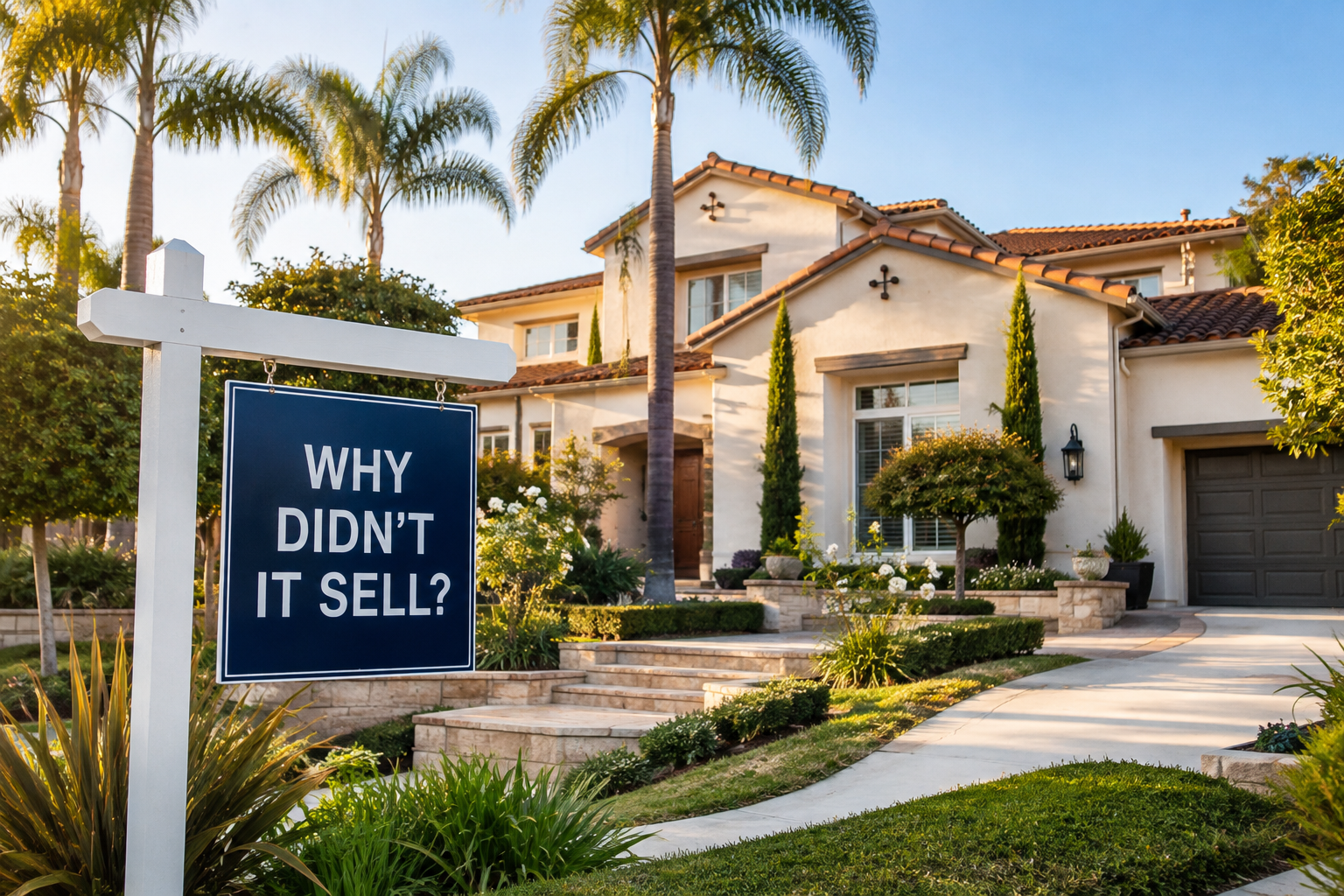
Before you cut the price again, change agents, or decide to wait until spring, there is one thing I would do first: find out exactly why buyers passed on the house.
If your Orange County home was on the market this summer and didn't sell, I wouldn't tell you that you “just missed the right buyer.”
I wouldn't automatically tell you to lower the price.
And I definitely wouldn't tell you to take it off the market and wait until spring.
I would start somewhere else.
I would study the listing that didn't sell.
Because after 30, 60 or 90 days on the market, we have something a seller didn't have before the home was listed:
Evidence.
We know how buyers responded.
We know which competing homes went into escrow while yours remained available.
We know whether buyers clicked on the property but didn't schedule a showing.
We know whether they toured it but didn't write an offer.
We know when the price was reduced and whether the reduction changed anything.
We know what buyers could purchase instead.
That information is valuable.
And throwing it away by simply putting the same house back on the MLS with different photos and a lower price is one of the biggest mistakes a seller can make.
Your Listing Didn't Run Out of Summer. It Ran Out of Leverage.
Orange County sellers faced a noticeably different market as the summer progressed.
Realtor.com inventory data shows 3,477 active listings in Orange County in March 2026. By July, that number had risen to 4,823 — an increase of nearly 39%.
At the same time, the number of Orange County listings that had a price reduction increased from 1,034 in March to 1,734 in July, a jump of almost 68%.
That doesn't mean Orange County real estate suddenly became a bad market.
It means buyers had more choices.
And when buyers have more choices, they become less forgiving.
A home can still sell for an excellent price.
But buyers are less likely to overlook an aggressive price, mediocre photography, deferred maintenance, confusing solar terms, an unexplained HOA, poor presentation or a listing that simply doesn't look as compelling as the alternatives.
That distinction matters.
Because the answer isn't always:
“Reduce the price.”
The real question is:
Where did the listing lose the buyer?
That's what I want to know before discussing a relaunch.
My 7-Point Listing Autopsy
When I look at an Orange County home that failed to sell, I don't start by preparing another generic CMA.
I start with what I call a Listing Autopsy.
The goal is to determine where the listing lost leverage and whether that problem was caused by price, positioning, presentation, marketing, buyer perception — or some combination of them.
Here are the seven things I want to know.
1. What Happened During the First Seven Days?
The first week tells me a lot.
A new listing should have something an older listing doesn't:
novelty.
Buyers who have been watching Irvine, Tustin, Orange, Fullerton, Anaheim or another Orange County market have already seen most of the existing inventory.
When something new appears, they notice.
So I look closely at the initial response.
Did buyers view the listing online?
Did they save it?
Did agents schedule showings?
Was the open house busy?
Were buyers interested enough to return?
Very few showings?
My first suspicion isn't that the home needs another open house.
It is that we have a price, positioning or online presentation problem.
Plenty of showings but no offers?
Now I'm looking somewhere else.
Maybe buyers liked the listing online but didn't see enough value once they walked inside.
That can point toward condition, floor plan, location, noise, updates, HOA, lot, disclosures or a price that looked reasonable online but didn't hold up after buyers compared the home in person.
Those are two completely different problems.
They shouldn't get the same solution.
2. Which Homes Did Buyers Choose Instead?
This may be the most important part of the analysis.
I don't just want three closed sales from the neighborhood.
I want to know what happened while your home was actually for sale.
Suppose your home sat for 58 days.
During those 58 days:
Which competing homes went pending?
Which homes sold?
Which properties received multiple offers?
Which ones reduced their price and then went pending?
Which listings were withdrawn?
Which homes are still sitting?
Then I compare them.
Because a buyer doesn't purchase a CMA.
A buyer purchases one home instead of another.
If three similar homes went into escrow while yours remained active, I want to understand why buyers chose those properties.
Maybe one was remodeled.
Maybe one had a better lot.
Maybe another was priced $75,000 lower.
Maybe yours actually was the better house — but the competing listing made that easier for buyers to understand.
That's not a small distinction.
That's positioning.
3. Did the Price Put the Home in the Wrong Search?
Here's something sellers rarely hear when discussing price:
Your asking price doesn't just determine what buyers think the house is worth. It can determine which buyers see it at all.
I’ve written before about how online price filters can cause Orange County buyers to miss homes, because even a small pricing threshold can determine whether a property ever appears in a buyer’s search.
Imagine a home listed at:
$1,525,000.
That may be perfectly defensible based on recent comparable sales.
But now look at it through the buyer's eyes.
How many buyers have set their maximum search price at $1.5 million?
If a meaningful portion of the likely buyer pool is searching from $1.2 million to $1.5 million, that $25,000 difference can place the listing outside their search entirely.
That's why I don't believe pricing is simply:
Comparable A sold for X.
Comparable B sold for Y.
Therefore your home is worth Z.
Pricing is also about where we place the property inside the buyer's decision set.
Sometimes the difference between $1,525,000 and $1,499,000 isn't merely $26,000.
It can be the difference between appearing in a buyer's search and not existing in it.
That needs to be analyzed before choosing a relaunch price.
4. What Did the First Five Photos Tell the Buyer?
Most homeowners understandably think about what their house looks like.
I think about something slightly different:
What does the listing look like next to every other house on the buyer's phone?
That's the real competition.
Buyers scroll quickly.
The first image has one job:
earn the second image.
The second earns the third.
And within seconds the buyer is deciding whether this home deserves an appointment.
If the strongest feature is a remodeled kitchen, view, backyard, corner location, oversized lot, dramatic living room or exceptional floor plan, I want to know why that advantage wasn't immediately obvious.
If thousands of buyers already scrolled past the same lead photograph this summer, I don't want to simply reactivate that photograph this fall.
A relaunch should look like something changed.
Otherwise the market sees the same house it already rejected.
5. What Were Buyers Actually Objecting To?
Buyer feedback becomes useful when you stop treating each comment individually and start looking for patterns.
I separate objections into two categories.
Things we can change:
Presentation.
Paint.
Landscaping.
Lighting.
Photography.
Staging.
Minor repairs.
Marketing.
How an HOA is explained.
How solar is explained.
How upgrades are communicated.
How the home's best features are positioned.
Things we can't change:
Lot location.
Street position.
Floor plan.
Nearby traffic.
School boundaries.
Certain HOA costs.
Property orientation.
Permanent view limitations.
If an objection can be corrected economically, we evaluate correcting it.
If it can't be changed, then the market needs to compensate for it somehow.
Usually through price or stronger perceived value elsewhere.
Pretending the objection doesn't exist is not a strategy.
6. Did the Seller Chase the Market Down?
This is one of the most expensive patterns I see in real estate.
A home starts too high.
Nothing happens.
Then:
$20,000 reduction.
Wait.
Another $20,000 reduction.
Wait.
Change the photos.
Wait.
Another reduction.
By the time the property reaches the price where buyers might originally have responded, it has been sitting for 60 or 90 days.
Now the buyer isn't only asking:
“Is this worth $1.45 million?”
They're asking:
“Why has nobody bought it?”
Those are psychologically different questions.
July 2026 data shows the median Orange County listing spent 48 days on the market, while 1,734 listings experienced a price reduction during the month.
Nationally, Realtor.com found that 20% of active listings received a price cut in July, with the West even higher at 21.9%.
A price reduction can absolutely be the right move.
But repeated reductions without a larger repositioning strategy can slowly teach buyers to wait.
They start wondering:
“If I wait another two weeks, will they reduce it again?”
That's the opposite of leverage.
7. What Was the Buyer Actually Buying Each Month?
This is one area where I think sellers and agents need to change the conversation.
A seller naturally focuses on the sale price.
Buyers increasingly focus on something else:
the monthly cost of owning the home.
Purchase price.
Interest rate.
Property taxes.
HOA.
Insurance.
Solar.
Mello-Roos or special assessments where applicable.
Those numbers eventually become one payment.
So when I evaluate a listing, I don't only ask:
“How much do we need to reduce the price?”
I also want to know:
“Is there a way to make this transaction more financially compelling to a qualified buyer while protecting more of the seller's net?”
Depending on the property, financing and transaction, a properly structured seller credit may sometimes create more perceived value for a buyer than an equivalent price reduction.
Other times, reducing the price is clearly the better decision.
There is no universal answer.
The point is that I want to run the numbers before giving away equity.
Now We Can Talk About Fall
Here's where I disagree with a lot of real estate marketing.
You're going to hear agents say things like:
“Fall buyers are serious.”
“There is less competition.”
“Your house will look beautiful with autumn decorations.”
That's not a strategy.
And Orange County doesn't exactly transform into Vermont in October.
The reason I believe some unsuccessful summer sellers should seriously consider a fall relaunch is much more practical.
By July, Orange County had 4,823 active listings, compared with 3,477 in March. But the flow of newly listed homes had already begun to pull back: new listings declined from 2,620 in June to 2,424 in July, roughly a 7.5% monthly decrease.
Pending listings also moved from 1,918 in June to 1,779 in July.
That tells me something important.
The market is not frozen.
But the environment is changing.
And that can create an opportunity for a seller who gets the relaunch right.
Fall Isn't Your Opportunity Because It's Fall.
Fall is your opportunity because now we have evidence.
We know what happened the first time.
We know what buyers ignored.
We know what they toured.
We know which homes they chose instead.
We know the objections.
We know the price history.
We know where competing inventory is sitting.
And we can use that information to create a smarter second launch.
Your unsuccessful summer listing effectively paid for market research.
Use it.
Should You Wait Until Spring Instead?
Maybe.
There are absolutely situations where I would recommend taking a home off the market, making improvements and returning later.
But I would never make that recommendation simply because someone told you that “spring is the best time to sell.”
Waiting doesn't fix anything by itself.
If the problem was the price, waiting doesn't automatically solve it.
If the photos were weak, waiting doesn't solve it.
If buyers didn't understand the value, waiting doesn't solve it.
If the property needed preparation, waiting only helps if you actually use the time to prepare it.
And next spring brings something sellers sometimes forget:
more sellers.
You may have more buyers looking.
You may also have a new wave of homes competing for their attention.
The correct question isn't:
“Is fall or spring better?”
The correct question is:
“In which market can we position this particular property most effectively?”
That's a property-specific answer.
Do Not Relist Your Home Until Your Agent Can Answer This Question
If you're interviewing agents after an unsuccessful listing, don't just ask:
“What do you think my house is worth?”
Almost anybody can produce a CMA.
Instead, hand them the old listing and ask:
“Why didn't this sell?”
Then listen carefully.
Can they show you which homes buyers chose instead?
Can they explain where the original pricing strategy broke down?
Can they tell whether the problem was traffic or conversion?
Can they identify the repeated buyer objections?
Can they explain how your home should be repositioned against today's competition?
Can they tell you what they would materially change?
And most importantly:
Can they explain why?
If the entire answer is:
“We need better marketing and a lower price.”
Keep interviewing.
If It Were My Listing, I Wouldn't Start With the New Price.
I'd start with the old listing.
I would pull apart the history.
I would look at the competition.
I would look at what sold.
I would look at what went pending.
I would look at the buyer feedback.
I would look at how the home appeared online.
I would look at the pricing thresholds.
I would look at the seller's net.
And only after I understood why the first strategy didn't work would I recommend the second one.
Because putting a home back on the MLS is easy.
Putting it back on the market with a reason for buyers to respond differently is the job.
If Your Orange County Home Didn't Sell This Summer, Send Me the Old Listing.
Don't send me your address because you want another automated home-value estimate.
Send me the listing that didn't sell.
I want to see how it was priced.
How it was presented.
How long it sat before changes were made.
What competed with it.
What sold around it.
And where I believe the listing lost leverage.
Then we can talk about what I would change before you put the property back in front of buyers.
Maybe the answer is price.
Maybe it isn't.
Maybe fall is the right window.
Maybe waiting is smarter.
I'll tell you what the data says — not what I need to say to get a sign in your yard.
James Deokar, REALTOR®
JD Signature Real Estate | BK Platinum Properties
Irvine & Orange County Real Estate
949-572-7098
[email protected]
Orange County market figures are based on Realtor.com housing inventory data for July 2026, accessed through the Federal Reserve Bank of St. Louis. Market conditions vary by city, neighborhood, property type and price range.
Check out this article next